For her one of her most meaningful projects is Habitat. It brought together everything. Işık Güner, botanic illustrator, cares about: scientific accuracy, fieldwork, storytelling and conservation. The artist divides her time among Turkey, Scotland and the field trips all around the world where wildflowers paint the meadow in bursts of color.
Milan, Italy.
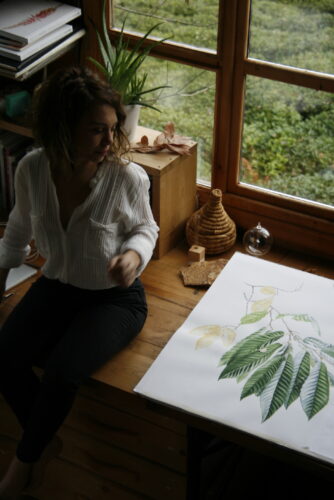
She divides her time among Turkey, Scotland and the field trips all around the world.
She become interested in botanical illustration
“The aim of botanical illustration is to produce not only a picture that is pleasing to the eye but one which is botanically accurate, comprehensive and recognisable to species level. Such works broach the gap between art and science”. Rosemary Wise – Botanical Illustrator, Oxford Botanical Garden
She divides her time among Turkey, Scotland and the field trips all around the world, reports from the mountain village where she lives that there is a growing recognition of botanical illustration as a tool for conservation and education. Collaborations between artists, scientists, and institutions are becoming more common, and audiences are increasingly interested in biodiversity, climate change, and ecological storytelling. This creates space for botanical art to be relevant, urgent, and meaningful.
“I have originally studied in Environmental Engineering in university at Istanbul. But my path has been shaped through both formal education and long years of self-directed fieldwork for this journey of botanical illustration. I have self – trained in botanical illustration with a strong scientific foundation, working closely with botanists, herbaria, and institutions such as Nezahat Gökyiğit Botanic Garden and the Royal Botanic Garden Edinburgh. Professionally, I work as an independent botanical artist, exhibiting internationally, publishing books, teaching workshops, and contributing to conservation-focused projects that document plant diversity”.
A single leaf falls, slow and brave, paintitng autumn in the air. “My interest grew very organically. I have always been deeply connected to nature, and over time I realized that drawing plants allowed me to observe them more closely and more honestly than any other method. Botanical illustration became a way for me to slow down, to really see—to understand plants not only as beautiful forms, but as living organisms with ecological, cultural, and historical stories. That combination of art, science, and attention felt like home to me”.
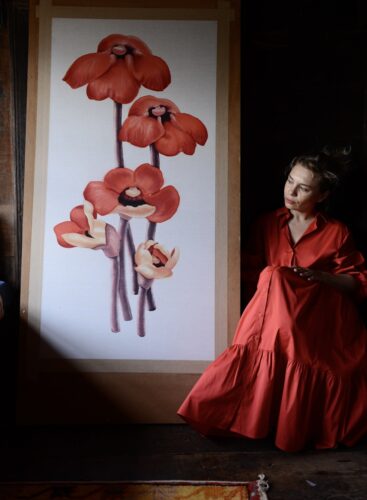
For her Plant illustration is a purely observational work.
The techniques she uses to create botanical illustrations. Her style.
For her Plant illustration is a purely observational work. Painting from a photograph is not suitable for scientific botanical illustration. “My work is primarily hand-drawn and painted in watercolor. I work on high-quality paper, usually Fabriano 300 gsm, and paint directly from live specimens whenever possible. I rely on detailed pencil drawings, careful tonal studies, and layered watercolor washes. I do not use digital tools in the creation process—precision, patience, and the physical act of painting are essential parts of my practice.
My style is rooted in scientific accuracy, but it has gradually become more expressive and confident. Early on, I focused intensely on correctness and technique. Over time, as my observation skills deepened, I allowed more space for movement, rhythm, and atmosphere—without compromising accuracy. Today, I aim for a balance: clarity and precision, paired with a quiet emotional presence”.
“I deeply admire artists who combine rigorous observation with sensitivity. Historical illustrators inspire me for their discipline and dedication, such as Ehret, while contemporary botanical artists, such as Dianne Sutherland, inspire me for expanding the field conceptually—connecting illustration with ecology, conservation, and storytelling. I value artists who respect plants as living beings rather than decorative objects”.
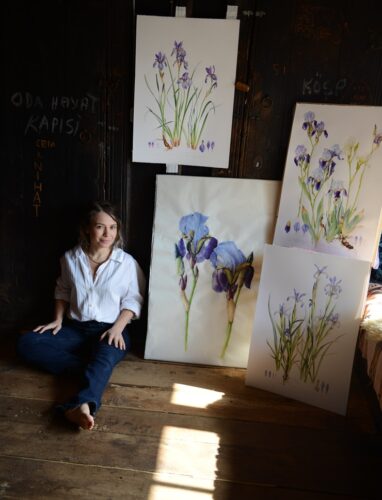
She has always been deeply connected to nature.
She draws inspiration from nature
“Nature itself is the source. Fieldwork is essential to my practice—walking, observing, waiting, sometimes returning to the same place many times. Inspiration often comes not from dramatic moments, but from quiet persistence: a plant that refuses to bloom, a leaf changing slowly, or a habitat under threat. These experiences shape not only what I paint, but why I paint.
Each project begins with research—scientific literature, herbarium specimens, and conversations with botanists. Then comes field observation: studying the plant in its natural habitat, making sketches, notes, and photographs. I work from live specimens whenever possible, documenting different stages—buds, flowers, fruits, leaves. Only after this deep familiarity do I begin the final painting”.
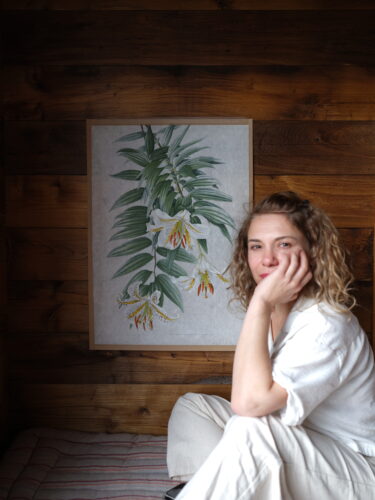
The project allowed her to document plants within their ecosystems, not as isolated subjects, but as part of a living, fragile whole. It reflects both her artistic journey and her concerns for the future of biodiversity.
“A single illustration can take anywhere from several days to a few months, depending on the complexity of the species and the availability of live material. The visible painting time is only part of it—observation, research, and waiting for the right moment are equally time-consuming”. “Plants do not follow our schedules, and working from live specimens requires flexibility and patience. Another challenge is conveying the ecological and scientific importance of plants in a world that often prioritizes speed and spectacle. Staying true to a slow, careful practice is both a challenge and a commitment”.
The advice would she give to someone starting a career in botanical illustration is “Learn to observe deeply and patiently. Build a strong foundation in drawing and plant structure. Work from life as much as possible, and do not rush the process. Botanical illustration is not about quick results—it is about dedication, humility, and long-term commitment to learning”. For her silence in the woods feels like the world is breathing slowly.
Info: https://www.isikguner.com
Photo courtesy of Işık Güner