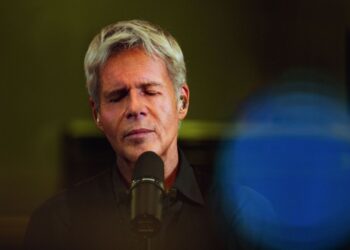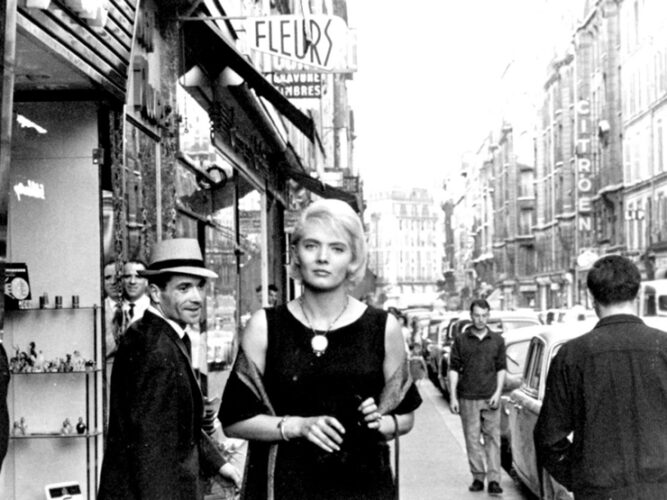
Above, Cleo From 5 to 7.
Small photo above, Bonnie and Clyde.
THE FILM SCHOLAR IS A WEEKLY COLUMN THAT FOCUSES ON ASPECTS OF FILM THEORY AND FILM HISTORY. THIS WEEK WE WILL LOOK AT THE WAYS IN WHICH YOUNG PEOPLE WERE PORTRAYED IN THE FRENCH NEW WAVE AND NEW AMERICAN CINEMA FROM THE 1960S.
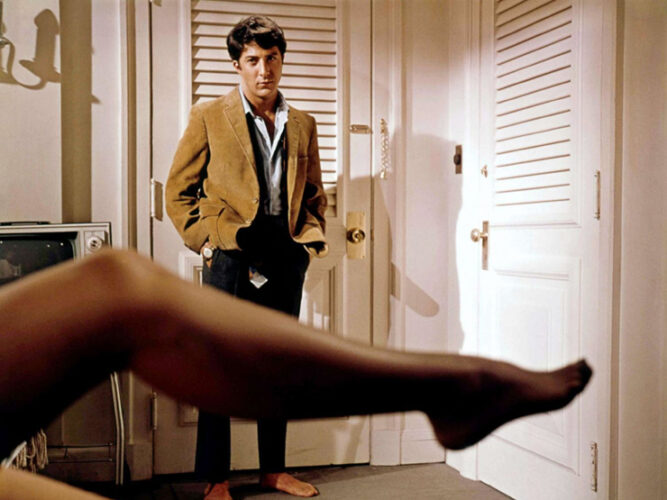
The Graduate
Paris, France / Los Angeles, USA
In the US, “at the end of World War II […] Young adults saw a remarkable rise in their spending power. Jobs were plentiful, wages were higher, and because of the lack of consumer goods during the war, Americans were eager to spend” (“The Rise of American Consumerism,” American Experience, PBS). On the hand, however, things in France were quite different, as, until the Fifth Republic and beginning of the 1960s, the country struggled greatly. Nevertheless, France did face some of the cultural revolutions happening in the US throughout the 1960s. It was a time of protest, rebellion, and idealism; the baby boom period gave young people an independence they had never had before and, consequently, much of the cultural and media attention began revolving around them. In France, indeed, “the news magazine L’Express chronicled the impact of ‘le baby boom,’ and in 1957… presented its findings as proof of a profound generational shift and announced the arrival of the ‘new wave’” (Tweedie, 2013).
While, in fact, the term ‘new wave’ referred to the youth, it ended up becoming what the Nouvelle Vague, perhaps Europe’s most renowned national film movement, was known as, thanks not only to a focus on youth in its films, but also to the great deal of young filmmakers that comprised it. On the other hand, in the US, the cult of youth in the film industry was shown not only by socio-cultural shifts and a new wave of directors, but also by box office admissions, of which by 1968 48% were from 18-to 24-year-olds. This essay will therefore explore the theme of youth in various aspects of filmmaking in respectively the Nouvelle Vague and New American Cinema.
The Nouvelle Vague
The first aspect to be analysed is the role of youth culture in the French Nouvelle Vague. Peter Lennon, foreign correspondent for the Guardian in Paris in the 1960s, writes about the Nouvelle Vague: “Imagine a thirteen-month period, from the May Cannes festival of 1959 to Cannes 1960, which produced Truffaut’s Les Quatre Cents Coups and his Tirez sur le Pianiste; Chabrol’s Les Cousins; Godard’s A Bout de Souffle; Jacques Demy’s Lola; Alain Resnais’s Hiroshima Mon Amour; Eric Rohmer’s Le Signe du Lion and Jacques Rivette’s Paris Nous Appartient. All these directors were under forty” (Lennon, 1994).
The Nouvelle Vague became so significant because it perfectly represented the changing cultural shifts of the country at the time, as well as the new established youth culture that had implemented these shifts. The new generation of film critics turned filmmakers, as “the intense love of cinema, or cinéphilie, experienced by this generation of young people was at the very heart of the New Wave,” (Greene, 2007) rejected the Tradition of Quality with “what Truffaut called a series of ‘refusals,’” (Greene, 2007) and gradually conquered the French film industry by challenging the themes explored in movies as well as “established models of making and producing films” (Greene, 2007).
The Search for Truth
In what they called the ‘search for truth’, New Wave filmmakers like Godard and Truffaut (who were still in their twenties when they made their first films) broke pre-existing rules by establishing their own: real locations, handheld cameras and the use of “young unknowns whose naturalistic acting and gift for improvisation contrasted greatly with the theatrical declamations of an older generation of performers” (Greene, 2007) introduced an aesthetic that became synonymous with the Nouvelle Vague and, in turn, with the themes it explored, like, above all, youth culture. Indeed, “coming from the ranks of the new generation, the young filmmakers of the late 1950s caught the bewildering alienation, the search for money and love, experienced by young people as they confronted a world in which traditional moral codes and political aspirations no longer held away” (Greene, 2007).
Such themes become apparent when looking at films like Agnès Varda’s Cléo de 5 á 7 (1962), in which the protagonist, a pop singer, anxiously wanders around the streets of Paris waiting for the result of a biopsy until she meets a soldier. Furthermore, in Truffaut’s Jules et Jim (1962), the viewer is presented with a story about friendship and love and how it evolves over a period of 30 years.
Truffaut, Godard and the Character of the French New Wave
Two aspects of the exploration of youth in Jules et Jim are worth pointing out. Firstly, Truffaut presents the audience with what might seem a classic love triangle, yet told from the starting point of three sexually open young people that live their lives, as Roger Ebert puts it, “of charm and freedom” (Ebert, 2004), as the Nouvelle Vague and its directors “were far more interested in the social, sexual and emotional problems of young adults (as, classically, in Godard’s 1966 Masculine-Femenine).” (Vincent, 1994). Secondly, Truffaut shares with the audience his own interpretation of the young person as an intellectual and an artist. The opening narration of Jules et Jim already tells us that: “they taught each other their languages; they translated poetry.”
It is perhaps more apparent, however, in other works like the semi-autobiographical coming-of-age drama Les Quatre Cent Coups (1959) or L’Enfant Sauvage (1970), as in both films the young protagonist struggling under the authoritarian power of adults could be interpreted as the artist struggling to freely share his artistic vision (the sequence in which Antoine Doinel is punished by a teacher after sketching on a pinup nude is the perfect metaphor of such theme), wanting ’to raise hell’ (faire les quatre cent coups) and eventually both films end in a flight.
What becomes clear is that “in Truffaut’s films he reimagines the conventions of boyhood. He sees the chaos, the trouble, the pain, and the rebellion, but reclaims the boy as artist” (White, 2005). This is somewhat in contrast with the way Jean-Luc Godard represents young people in his films. In the previously mentioned Masculine-Femenine (1966), for example, Godard, like other Nouvelle Vague directors, “captures the current youthful scene- its energies and wonders, confusions and dead ends” (Casty, 1967), but his representation of young people is shown by the characters of Paul, played, like Antoine Doinel, by Jean-Pierre Léaud, and Madeleine, who, like Cléo in Varda’s film, is a pop star. The two challenge traditional conceptions of sexuality: they begin a ménage à quatre with Madeleine’s roommates, and when she gets pregnant, that pregnancy never becomes a focus of the film. The struggle for freedom is not an intellectual one, but rather a sexual one.
The same happens in À Bout de Souffle (1960), where the character of Michel not only does not have any intellectual pretences, but even despises them. Furthermore, the exploration of sexual themes concerning young people can be found in other films like Georges Franju’s Les Yeux Sans Visage (1960), which “contains no overt reference whatever to sexuality, yet it carries an undeniable erotic charge, fuelled doubtless by the very sexual repressiveness of which it speaks” (Vincent, 1994), and that reflects the sexual revolution going on in the country throughout the decade, and even its repression, as “more than half the films distributed in France at the beginning of 1969 were cut by the censor” (Vincent, 1994). What ultimately becomes clear is how the Nouvelle Vague represented the gain of independence, both in the arts and socially, of France’s youth in the 1960s.
New American Cinema
The second aspect to be analysed is the role of youth in New American Cinema. As previously mentioned, The US in the 1960s faced a time of both civil and political unrest, as well as a social revolution led mostly by the American youth, and this was also shown in the cinema industry. Indeed, “influenced by companies such as American International Pictures, which specialised in cheaply made films explicitly made for the youth market, many films reflected the counterculture and Hollywood’s brief flirtation with overt left-leaning subject matter” (Milliken, 2008). With the introduction of new age-based ratings, filmmakers were able to explore new themes in a way that could reflect the ongoing cultural changes of the US. From the civil rights movement, the hippie movement, the 1967 Summer of Love to the LGBT rights movement with events like the Stonewall Riots of 1969, historical events would openly influence a new current of cinema, more grounded in realism with political and social commentary.
Hollywood’s Sexual Liberation
For example, “one Hollywood film that addressed the period’s ethos of sexual liberation, though from a pointedly heterosexual perspective, was Bob & Carol & Ted & Alice” (Milliken, 2008), in which the conservative mindset of two couples is overturned, and the practice of free love is explored as a theme. Another movie influenced by the sexual revolution of youth is The Graduate (1967), in which sexuality in a bourgeois environment is explored from the perspective of college graduate Benjamin, played by Dustin Hoffman, who is seduced by the wife of his father’s business partner.
Perhaps, though, the clearest example of the changes Hollywood was implementing is with Arthur Penn’s 1967 crime drama Bonnie and Clyde. Not only the film was incredibly violent and explicit for the time, with the ending in which the two young gangsters are shot that is somehow reminiscent of the Kennedy murder, but it is also very open in the way it deals with sexuality. Clyde, played by Warren Beatty, is impotent, while “Bonnie Parker is played by Faye Dunaway… as one of the first, perhaps the first, blatantly sexually hungry females in American film” (Pomerance, 2008). The importance of Bonnie and Clyde in its exploration of youth culture’s mindset is further emphasised by Lester D. Friedman, who states that “the film stood… at a profoundly significant cultural crossroads: a point where American values veered from a comfortable fifties’ mentality to a more complicated reconfiguration of the world; where the old Hollywood system cracked under the impact of new ideas and technologies” (Pomerance, 2008).
Dennis Hopper and Hippie Culture
The sexual revolution, however, was only a small part of the themes close to counterculture that cinema had started exploring. The whole hippie culture became an integral part of New American Cinema, with films like The Trip (1967) with Peter Fonda and Dennis Hopper, which focused on the role of drugs in those years, and Easy Rider (1969), which not only explored hippie culture, but also delved into the internal divisions of American society, with the clash between conservativism and counterculture, and the violence that can consequentially erupt. Director Dennis Hopper, to make the film, sort of went through his own personal rebellion against the system, as he stated he “would die before an artist such as himself would take orders from a bunch of pencil-necks in three-piece suits” (Bramesco, 2019), a sentiment symbol of the mindset of many emerging directors of the time, like Martin Scorsese. The film’s theme of the quest for freedom became a manifesto for a generation, as “Hopper’s middle finger to the establishment struck a chord with a public in thrall of the country’s youth movements, who could relate to Billy and Wyatt’s ( the film’s protagonists) desire to be and stay wild” (Bramesco, 2019). New American Cinema, therefore, was essentially a movement highly inspired by the youth culture and the social revolution it had implemented, both in its style and in the themes it explored.
Conclusion
In conclusion, youth culture was perhaps the same source of influence for both the Nouvelle Vague and New American Cinema, as the emergence of new filmmakers with original visions meant that the themes their films explored were very often aspects of the cultural revolutions happening in their respective countries.
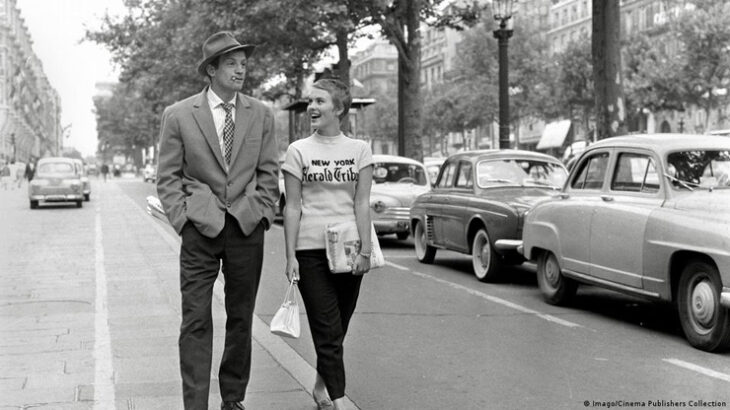
À Bout De Souffle
BIBLIOGRAPHY:
Bramesco, Charles. ”Easy Rider at 50: How the Rebellious Road Movie Shook Up the
System.” The Guardian, July 15, 2019.
https://www.theguardian.com/film/2019/jul/15/easy-rider-at-50-how-the-rebellious-road-
movie-shook-up-the-system
Casty, Alan. ”Masculine-Femenine.” Film Quarterly Vol.20, no.4 (Summer 1967): 57-60.
Jstor.
Ebert, Roger. “Jules and Jim.” June 20, 2004. Rogerebert.com.
Greene, Naomi. The French New Wave: A New Look. London: Wallflower Press, 2007.
Lennon, Peter. Foreign Correspondent: Paris in the Sixties. London: Picador, 1994.
Milliken, Christie. ”1969: Movies and the Counterculture.” In American Cinema of the 1960s: Themes and Variations, edited by Barry Keith Grant, 217-238.
New Brunswick: N.J. Rutgers University Press, 2008. ACLS Humanities E-Book.
PBS. “The Rise of American Consumerism.” American Experience. accessed January 7, 2021. https://www.pbs.org/wgbh/americanexperience/features/tupperware-consumer/
Pomerance, Murray. ”1967: Movies and the Specter of Rebellion.” In American Cinema of
the 1960s: Themes and Variations, edited by Barry Keith Grant, 172-192.
New Brunswick: N.J. Rutgers University Press, 2008. ACLS Humanities E-Book.
Tweedie, James. The Ages of New Waves: Art Cinema and The Staging of Globalization. Oxford: Oxford University Press, 2013. ACLS Humanities E-Book (HEB).
Vincent, Amiel. ”Tous les Garçons et Les Filles de Leur Âgé.” Positif- Revue Mensuelle de Cinéma (December 1994): 32-35.
https://journals.sagepub.com/doi/pdf/10.1177/095715589600702103.
White, Patrick E. ”Portrait of the artist as a young boy: François Truffaut, Antoine Doinel and The Wild Child.” In Where The Boys Are: Cinemas of Masculinity and Youth,
edited by Murray Pomerance and Frances Gateward, 217-232.
Detroit: Wayne State University Press, 2005. ProQuest.
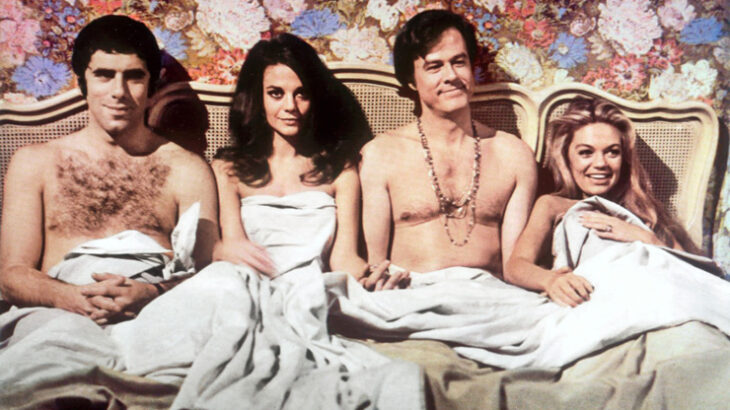
Bob & Carol & Ted & Alice
FILMOGRAPHY:
Les Quatre Cents Coups. Directed by François Truffaut. Performed by Jean-Pierre Léaud,
Claire Maurier. France: Les Films du Carrosse/ Sédif Productions, 1959.
Tirez Sur Le Pianiste. Directed by François Truffaut. Performed by Charles Aznavour,
Marie Dubois. France: Les Films de la Pléiade, 1960.
Les Cousins. Directed by Claude Chabrol. Performed by Gérard Blain, Jean-Claude Brialy.
France: Ajym Films/ Société Française du Cinéma pour la Jeunesse, 1959.
À Bout de Souffle. Directed by Jean-Luc Godard. Performed by Jean-Paul Belmondo,
Jean Seberg. France: Les Films Impéria/ Les Productions Georges de Beauregard/
Société Nouvelle de Cinématographie (SNC), 1960.
Lola. Directed by Jacques Demy. Performed by Anouk Aimée, Marc Michel. France/Italy:
Rome Paris Films, 1961.
Hiroshima Mon Amour. Directed by Alain Resnais. Performed by Emmanuelle Riva,
Eiji Okada. France: Argos Films/ Como Films/ Daiei Studios, 1959.
Le Signe du Lion. Directed by Éric Rohmer. Performed by Jess Hahn, Michèle Girardon,
Van Doude. France: Ajym Films, 1962.
Paris Nous Appartient. Directed by Jacques Rivette. Performed by Betty Schneider,
Giani Esposito, Françoise Prévost. France: Ajym Films, 1961.
Cléo de 5 à 7. Directed by Agnès Varda. Performed by Corinne Marchand.
France/Italy: Ciné-tamaris/ Rome Paris Films, 1962.
Jules et Jim. Directed by François Truffaut. Performed by Jeanne Moreau, Oskar Werner,
Henri Serre. France: Les Films du Carrosse/ Sédif Productions, 1962.
Masculine-Femenine. Directed by Jean-Luc Godard. Performed by Jean-Pierre Léaud,
Chantal Goya. France/Sweden: Anouchka Films/ Argos Films/ Sandrews, 1966.
L’Enfant Sauvage. Directed by François Truffaut. Performed by Jean-Pierre Cargol,
François Truffaut. France: Les Artistes Associés/ Les Films du Carrosse/
Les Productions Artistes, 1970.
Les Yeux Sans Visage. Directed by Georges Franju. Performed by Pierre Brasseur,
Alida Valli. France/Italy: Champs-Élysées Productions/ Lex Film, 1960.
Bob & Carol & Ted & Alice. Directed by Paul Mazursky. Performed by Natalie Wood,
Dyan Cannon, Elliott Gould, Robert Culp. USA: Columbia Pictures, 1969.
The Graduate. Directed by Mike Nichols. Performed by Dustin Hoffman, Anne Bancroft.
USA: Lawrence Truman Productions, 1967.
Bonnie and Clyde. Directed by Arthur Penn. Performed by Warren Beatty, Faye Dunaway,
Gene Hackman. USA: Warner Bros, 1967.
The Trip. Directed by Roger Corman. Performed by Peter Fonda, Dennis Hopper,
Bruce Dern. USA: American International Pictures (AIP), 1967.
Easy Rider. Directed by Dennis Hopper. Performed by Peter Fonda, Dennis Hopper,
Jack Nicholson. USA: Pando Company Inc./ Raybert Productions, 1969.