Above, Picture 2.
Small photo above, the film poster
THE FILM SCHOLAR IS A WEEKLY COLUMN THAT FOCUSES ON ASPECTS OF FILM THEORY AND FILM HISTORY. THIS WEEK WE WILL LOOK AT THE OPENING OF 1991’S POINT BREAK, STARRING KEANU REEVES AND PATRICK SWAYZE.
Picture 4
Los Angeles, USA
A Night at The Movies in 1991
In 1991 any moviegoer who would walk into a theatre having just bought a ticket to a new James Cameron-produced flick from the director of Blue Steel (1989) was expecting an action-packed, popcorn movie made with the intention of keeping everyone on the edge of their seats through intense chase sequences the same way other popcorn films like Top Gun (1986) had done before. Did moviegoers get what they were expecting? Yes. Did they get more, however? I believe so. When Point Break was released, viewers were only in part presented with the entertainment derived from all the tropes and styles of action movies in the late 80s and early 90s, like the “intensified continuity” (Bordwell, 2002) that David Bordwell attributes to films of that time, or the over-the-top celebration of masculinity, as the reason the picture struck a chord with audiences is the way director Kathryn Bigelow subverts and plays with genre stereotypes to explore bigger and deeper themes. Point Break is essentially a movie about freedom; freedom within the law, freedom outside the law, and the way it expands on it is through an examination of masculinity. On that note, Priscilla Page points out that “Point Break reinvented masculinity, abandoning a certain kind of 80s machismo” (Page, 2017). The viewer, indeed, is catapulted right from the opening credits into the world of the story as the movie wastes no time introducing its two main characters and their beliefs, even if they do not speak a word the entire time. This essay will explore how the opening of Point Break, through its mise-en-scéne (with a particular focus on space, sound, framing, performance and décor) and editing, introduces the narrative dynamics of the film and analyses the themes of masculinity and freedom. I will guide you through the scene frame by frame, but I suggest you watch the film’s opening, which I will link here (https://www.youtube.com/watch?v=M8daVFhrGww), before you keep on reading.
The Opening
The movie opens with a shot of the sea. The light of the sun is warm, the spectator feels comfortable despite the sea being usually depicted as dangerous. The are no surfers yet in action: the sea in the only protagonist of the shot. It is made clear from the very start that the ocean is not just a ‘location’, but a character in its own right; it works as a sort of narrative agora. While it could be argued that the whole shot is out of focus, I believe a specific framing choice was made. The sound, in fact, is put at the forefront. The waves breaking onto the beach sound distant, the viewer knows they are present, just like the out-of-focus image puts a distance between him and the sea, but still gives it a sense of presence. This sense of distance is further emphasised by the ethereal music that accompanies the shot, which elevates the spectator above the current action (as the high angle of the shot also suggests). We are not in the movie yet; we are at its doorstep (see picture 1).
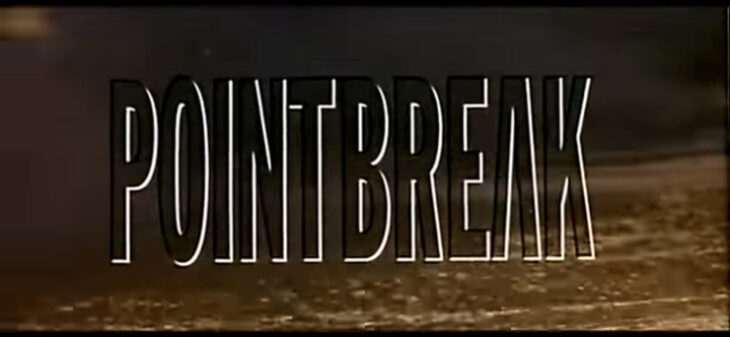
The credits start to roll, coordinated by the movement of the image and the sound as if they were part of the frame themselves. The names of the stars of the movie, Keanu Reeves and Patrick Swayze, slowly intertwine with each other in the middle of the screen to then be separated again. It could be interpreted as a foreshadowing of the interplay between Johnny Utah and Bodhi seen during the film. The title finally becomes clear and readable, covering most of the screen, until the sound of the waves suddenly gets louder and takes all the attention as the letters are swept away like they were part of the wave, and we finally cut to a surfer on his board: the movie has officially started. It is at this point where we begin to cut back and forth between Bodhi and Utah as their characters are introduced.
Bodhi and Utah
First, we get a full shot of Bodhi in slow motion entering the water with his surfboard. The camera does not follow him with a left pan, but rather stays still, in awe of the surfer as he comfortably begins his ‘dance’ with the sea along with the warm light of the sun in the background. The low angle of the shot further emphasises the power Bodhi transmits viewers when he surfs. In the next shot we once again see Brodhi from a low angle as he gloriously rides the waves (see picture 2). When Bodhi approaches the camera, our vision is blurred by the water and we can’t see the surfer anymore; he has escaped from us like he will escape numerous times throughout the movie. In this shot the camera’s vision is blurred out by the water the same way human vision would be, as Bigelow intended the whole movie to be as immersive as possible and to make the viewer feel literally inside the narrative. Later in the movie this will be achieved using handheld cameras which, as Bigelow herself has stated, is the “way the human eye perceives momentum” (2019).
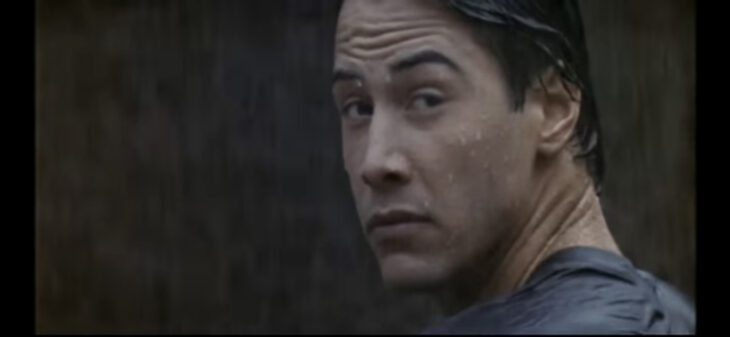
Right after the camera’s vision is blurred out, we cut to Johnny Utah, sitting on his car, under the rain, a gunshot in his hand (see picture 3). It is a drastic and intentional shift from the previous shot, as, with mise-en-scéne and colour grading, the difference between the two characters is emphasised. The music becomes more solemn, like a military hymn, as a whistle is blown by an FBI trainer, who points towards Utah, outside the frame. We then get a close-up of the film’s protagonist, who, in typical 90s style, turns his face towards the camera (see picture 4). Two things stand out from this shot that are directly comparable to the shots we saw of Bodhi. Firstly, this shot of Utah is a close-up and we never get a close-up of Bodhi. We actually never get to see Bodhi’s face at all during the opening credits. This is done to achieve a sense of mystery surrounding Brodhi’s character, as throughout the whole movie he does not simply represent a specific person, but rather an idea; an idea of freedom from the system, the same way that Heath Ledger’s Joker in The Dark Knight (2008) did not have a backstory or a clear goal, he just represented the idea of total anarchy. Secondly, in the shot of Utah’s face the camera is put at mid-angle, whilst in all of Bodhi’s shots the camera is placed at a low angle; the viewer is placed at the same level as Utah, we are supposed to identify with him and to recognise he is the protagonist, while Brodhi is perceived as an external figure that will cross paths with the protagonist, but nevertheless incredibly important, as shown by the low angle which emphasises his power.
The next two shots of Utah, a cowboy shot and a close-up, show the protagonist put on a ‘mean face’ and load the shotgun (see picture 5); it may seem like the new all-American hero, but I can’t help to think that there is an intent to subtly ridicule the all-American hero, not create a new one. Keanu Reeves, in fact, before 1991 was mostly known for the Bill and Ted movies (1989-1991), which certainly were not action flicks. In addition, as once again Priscilla Page points out, “Reeves’s performance is camp, a parody of machismo that softens as he evolves during the course of the film” (Page, 2017).
From this point on the editing starts to pick up the pace, cutting between Utah training and shooting at the targets and Bodhi riding the waves (see picture 6). They may be doing very different activities, but the editing manages to connect the two characters so well that at one point when Bodhi starts to turn around with his surfboard, we cut to a shot of Utah finishing that movement, with the only difference that he is rolling on the ground getting ready to shoot another target down. The pace of the sequence becomes exhilarating, cutting back and forth more often, and even the camera movements become less static, with far more pans than before. The only difference between the two settings (the sea and the training ground) is that Bodhi’s movements are still shown in slow motion, emphasising again that ethereal quality to his actions.
The Sound
It is crucial to point out once again the role of sound in this sequence, both diegetic and non-diegetic. While the sound of the waves perfectly accompanies the soundtrack, as if they were made together, the sound of the gunshots seems to break that harmony and bring the spectator back to reality, something that is further emphasised by the confusion created and the speed conveyed by the editing during the training ground shots. As Heidi Wilkins states, “the ambient sounds of water are used to create a soundscape that binds the two central characters, which is key in creating a homoerotic connection between them” (Wilkins, 2010). This connection is broken by the gunshots, perhaps showing that we are still at the beginning and the two characters have not bonded yet. The final shot of Utah smiling after being told “100 percent” shows how, despite their differences, the two characters are ultimately doing what they love: Utah feels free within the system, Bodhi feels free outside of it.
Picture 1
Conclusion
In conclusion, the opening credits of Point Break are the perfect introduction to the world of the film. Through its mise-en-scené and editing the viewer is immediately introduced to the main characters and their beliefs, as well as already delving into themes such as the perception of freedom and masculinity.
Bibliography:
• Bordwell, David. “Intensified Continuity.” Film Quarterly 55.3 (2002): 16-28. ProQuest.
• Page, Priscilla. “POINT BREAK: Kathryn Bigelow Subversive Surf Western.”Birth.Movies.Death:April12,2017. https://birthmoviesdeath.com/2017/04/12/point-break-kathryn-bigelows-subversive-surf-western
• VHS Video Vault. “Moving Picture- Kathryn Bigelow on Point Break.” Published July 5, 2019. https://www.youtube.com/watch?v=jXm1iDrofEM
• Wilkins, Heidi. “Surfing a Political Soundscape: Kathryn Bigelow’s “Point Break.” The Soundtrack 3.2 (2010): 97-107. https://doi.org/10.1386/st.3.2.97_1
Filmography:
• “POINT BREAK”, Kathryn Bigelow (1991), USA.
• “BLUE STEEL”, Kathryn Bigelow (1989), USA.
• “TOP GUN”, Tony Scott (1986), USA.
• “THE DARK KNIGHT”, Christopher Nolan (2008), USA.
• “BILL AND TED’S EXCELLENT ADVENTURE”, Stephen Herek (1989), USA.
• “BILL AND TED’S BOGUS JOURNEY”, Peter Hewitt (1991), USA.